Inside a Connected V16 Warning Light: The OSRAM LEDguardian Teardown
- Sascha Thiergart
- Company updates
- November 27, 2026
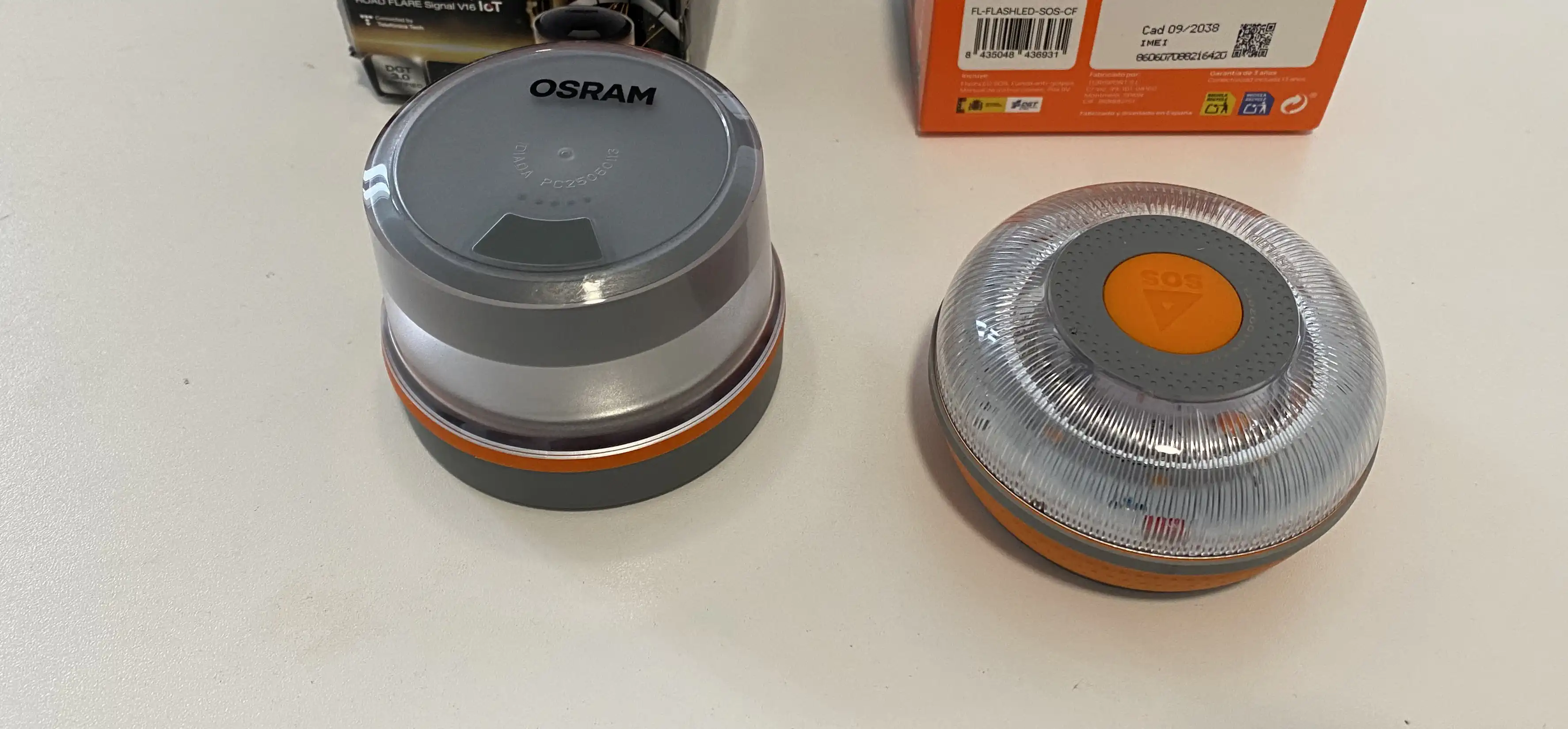
In our OpenFlare introduction we promised to start with a screwdriver. This is the first of five V16 warning lights we are taking apart: the OSRAM LEDguardian ROAD FLARE Signal V16 IoT. Here is what is inside, how it is put together, and what we learned about fitting a radio and its antennas into such a small device.
At a glance
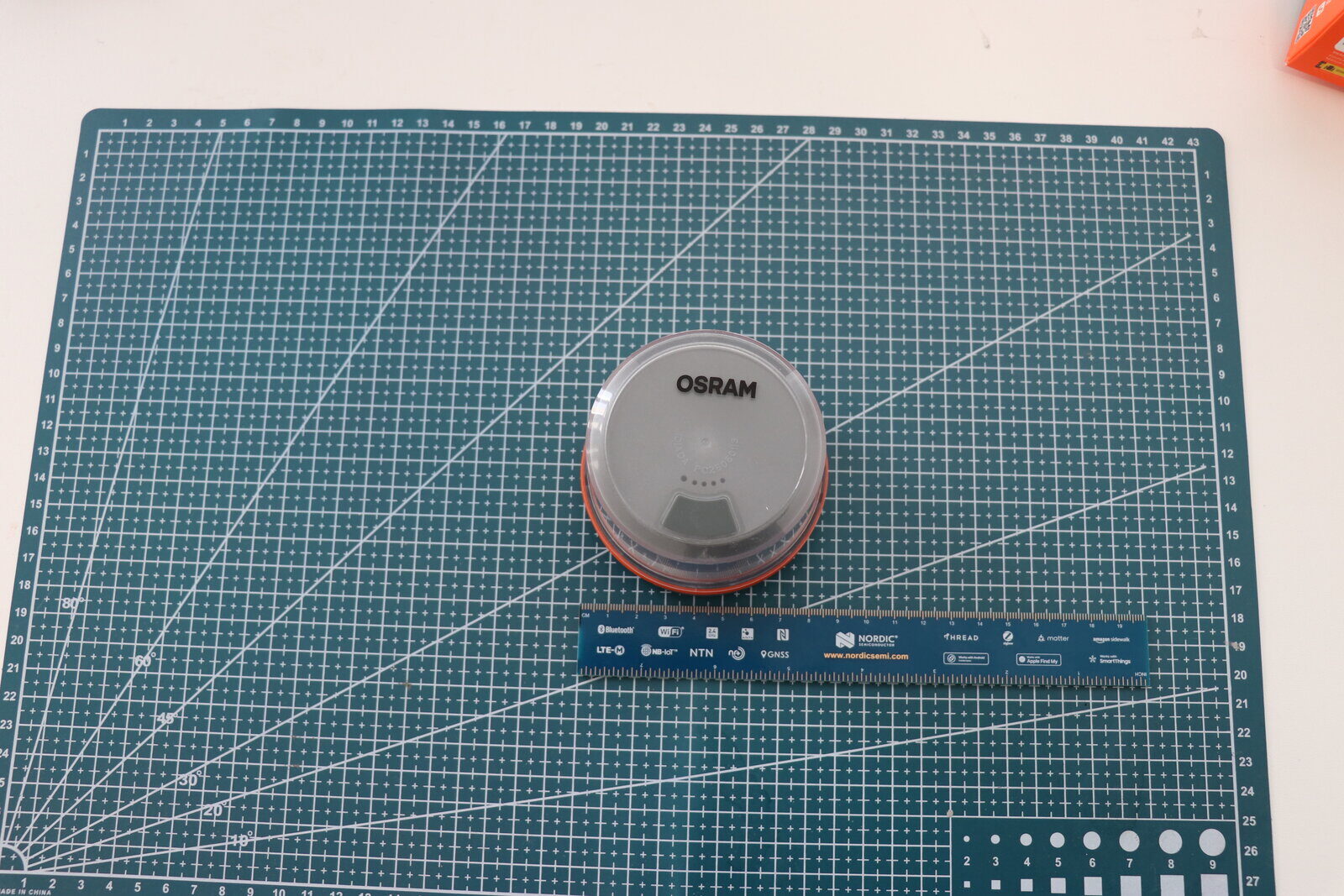
| Approval | Spanish DGT 3.0 connected V16, IP54 (according to the packaging) |
| Size | 84 mm diameter, 60 mm high |
| Battery | One 9 V alkaline block |
| Radio | Quectel BC680Z-EU: NB-IoT with built-in GNSS |
| SIM | Soldered eSIM, connectivity by Telefónica Tech for 12 years |
| Antennas | Two PCB antennas (GNSS and LTE B20) |
| Light | 10 amber LEDs shining into a mirrored cone |
| Circuit board | One circular PCB 70 mm diameter |
How it is built
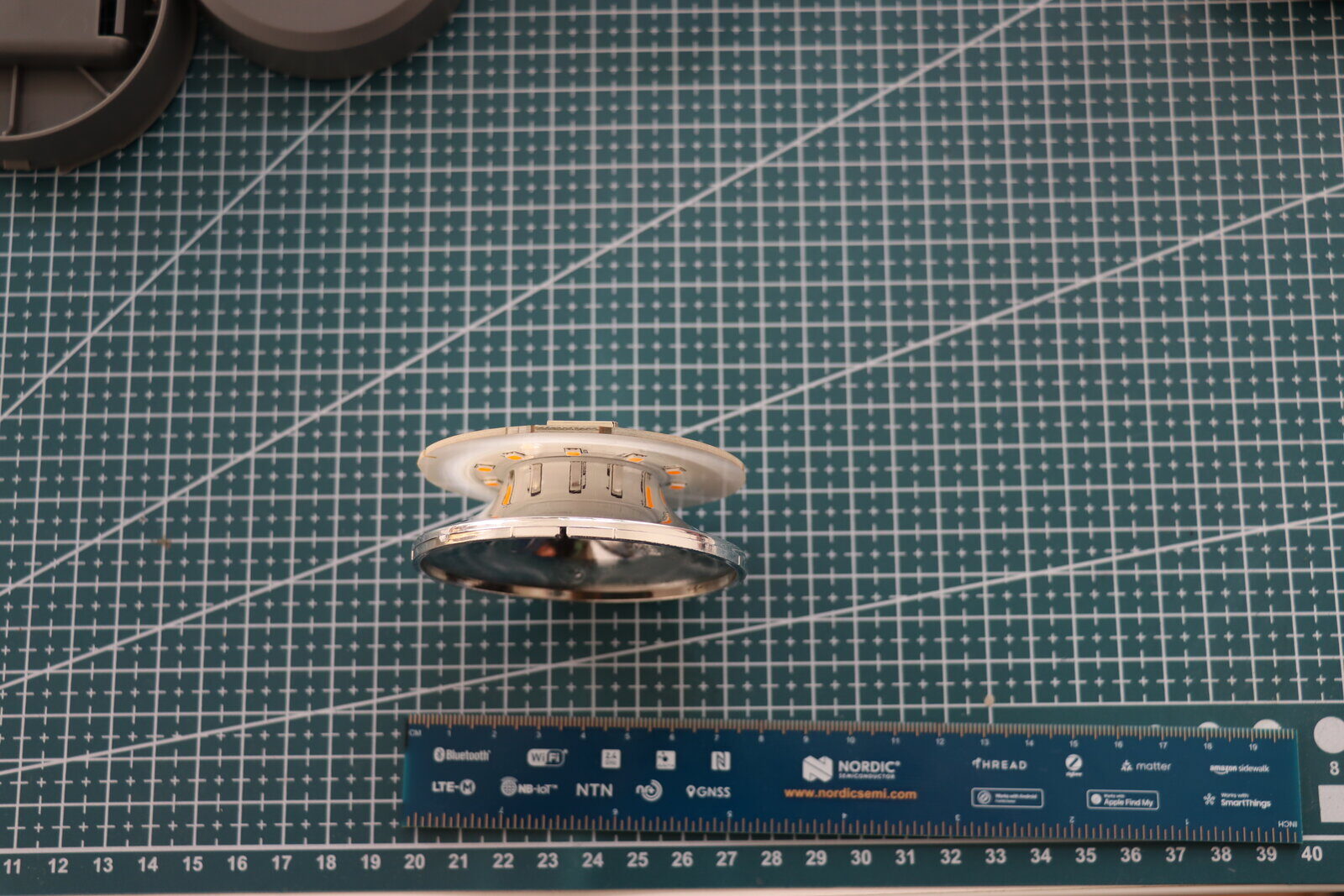
The light comes apart into a handful of parts. Seen from the car roof upwards:
- Base with the 9 V battery and two magnets that hold the light on the roof.
- Clear lens, which forms the outer wall and the window the light shines through.
- Mirrored cone, a plastic reflector with a metal coating.
- Circuit board, screwed onto the cone.
- Top cover with the button and five small light guides for the status LEDs.
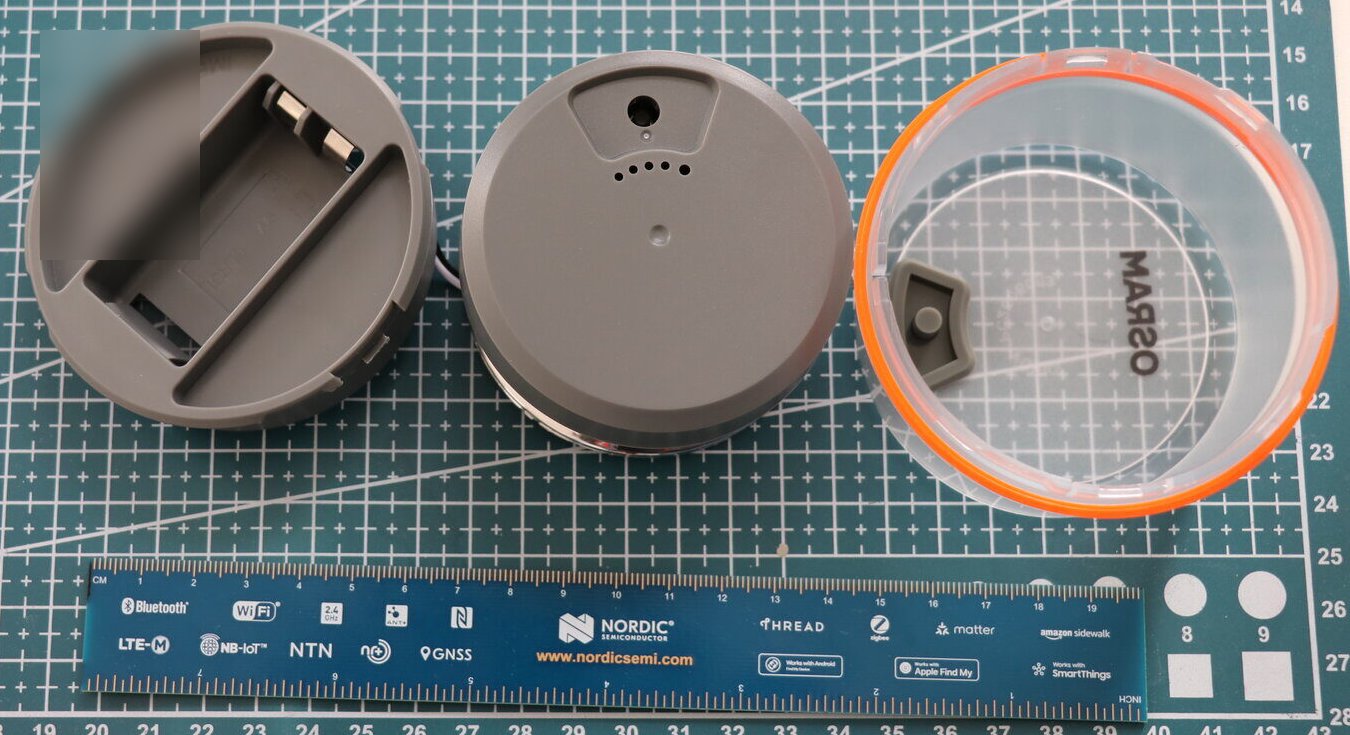
Opening it is simple. Twist the base off the head, take out the battery, lift off the top cover, and pull the board and cone out of the lens. A short cable carries the battery power from the base up through the middle of the cone to the board.
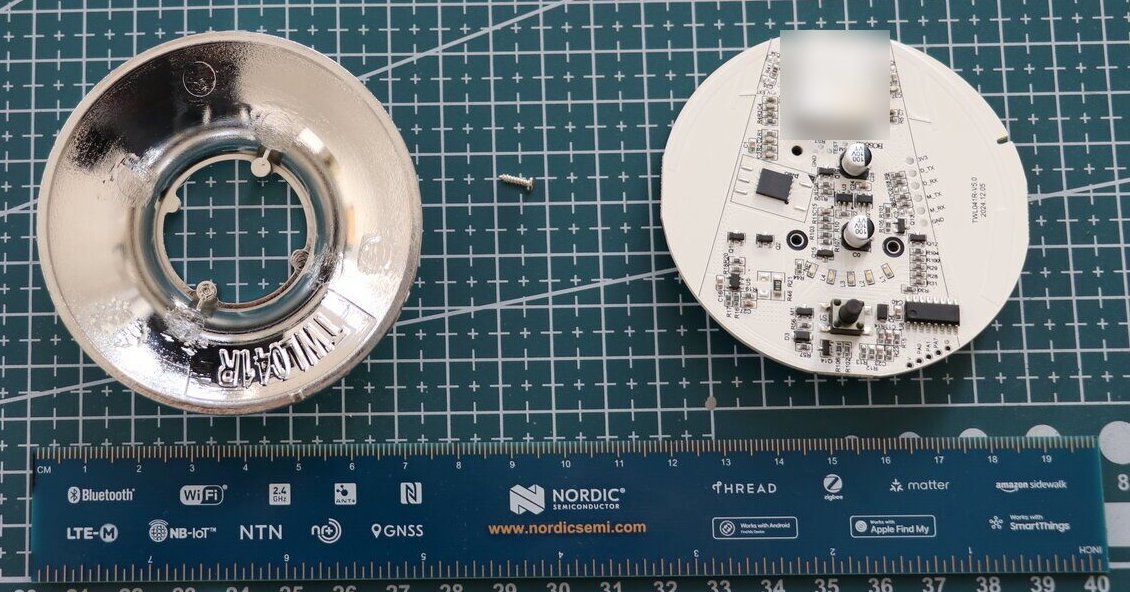
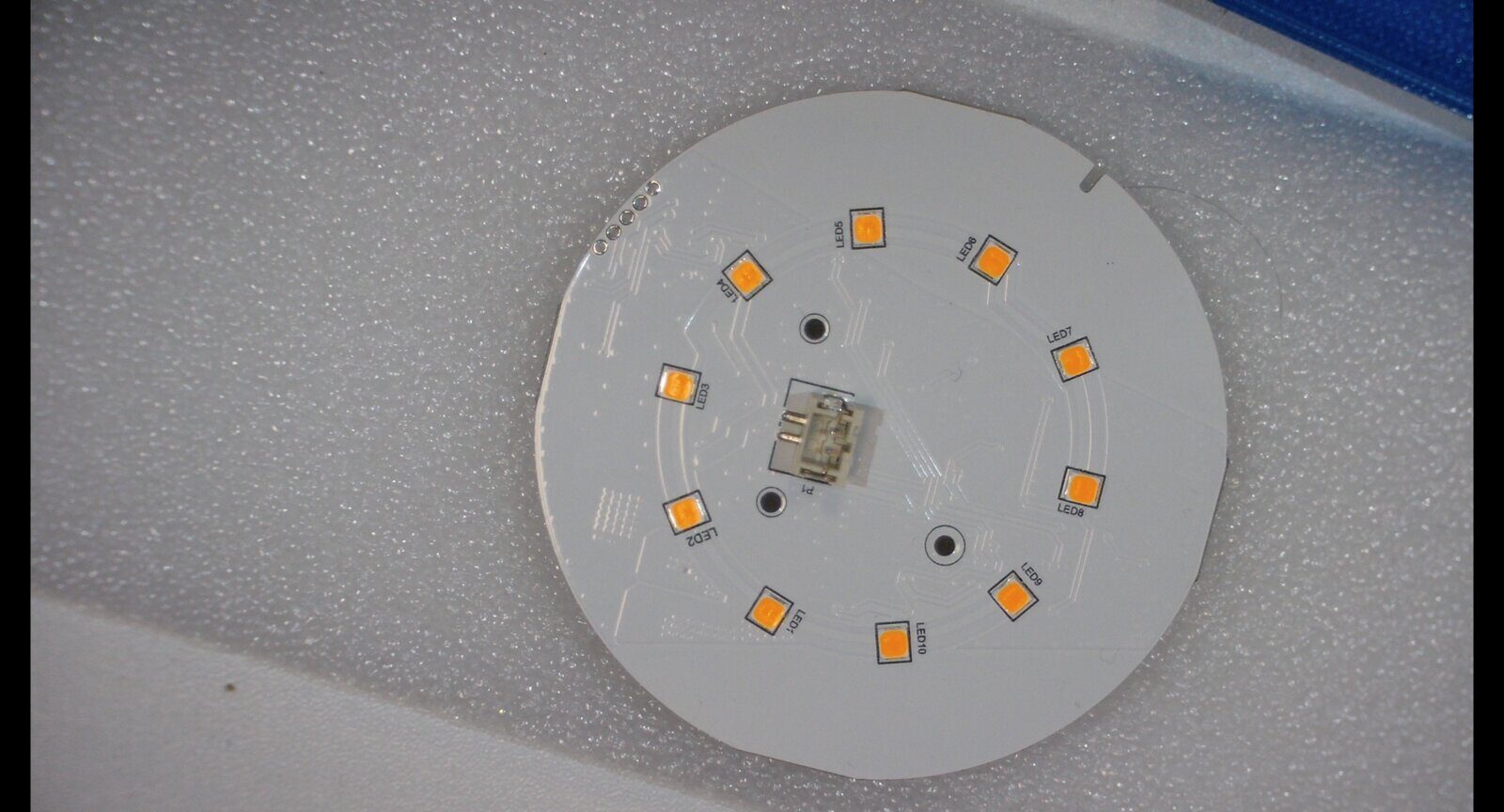
The LEDs sit on the underside of the board and point down into the cone. The cone throws the light out sideways, all around, through the clear lens. That gives a 360-degree warning light from a single flat board.
The PCB
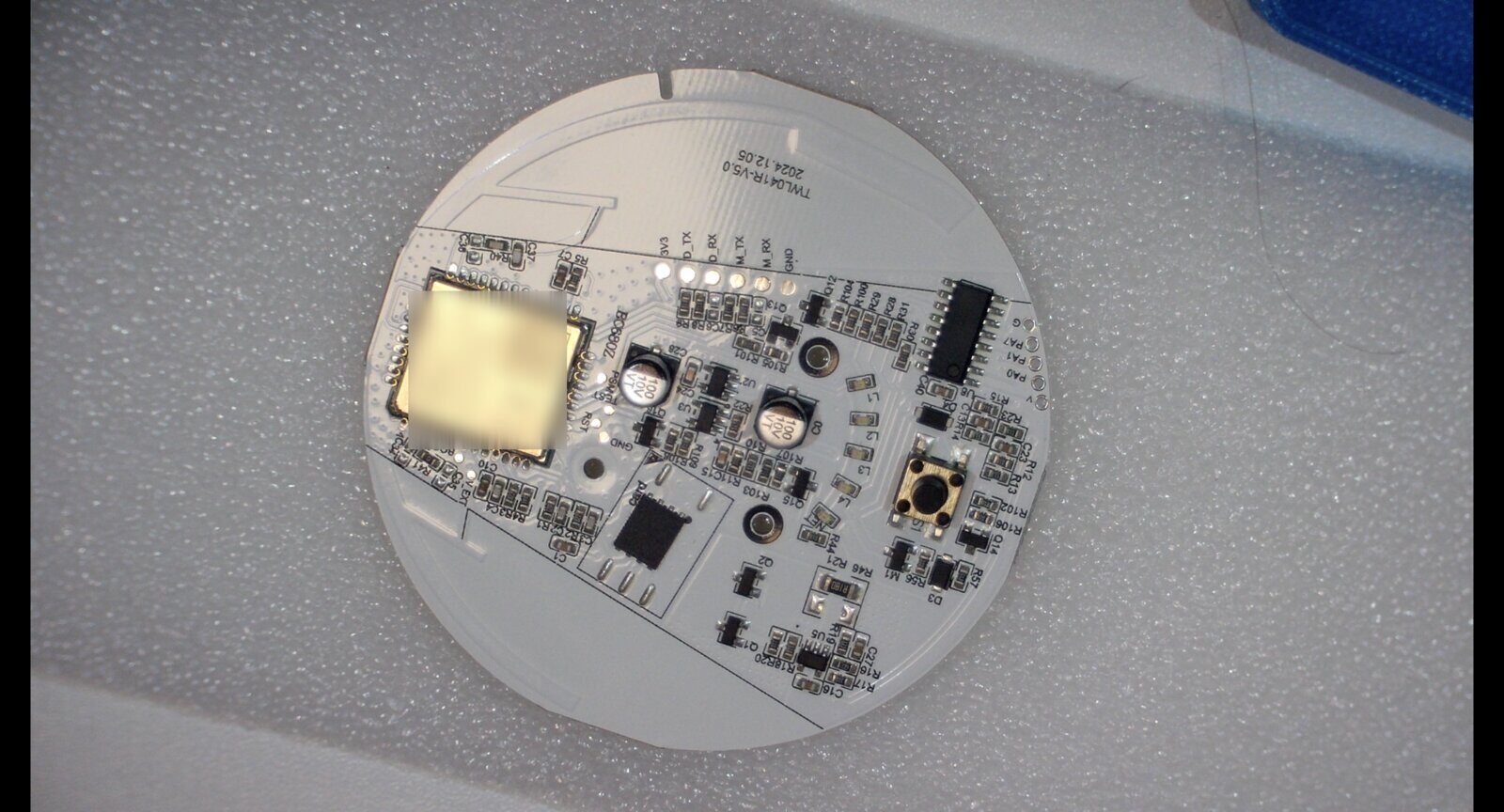
All the electronics sit on a single round PCB with 70 mm diameter. The top side carries the radio, the eSIM, the power supply, a small control chip, the button and the status LEDs. The bottom side carries the ten warning LEDs and the battery connector.
The radio
The radio is a Quectel BC680Z-EU module. It supports NB-IoT, a cellular standard designed for small devices that send little data and need to run on a battery for years. The module also includes a GNSS receiver, so the light can find its own position.
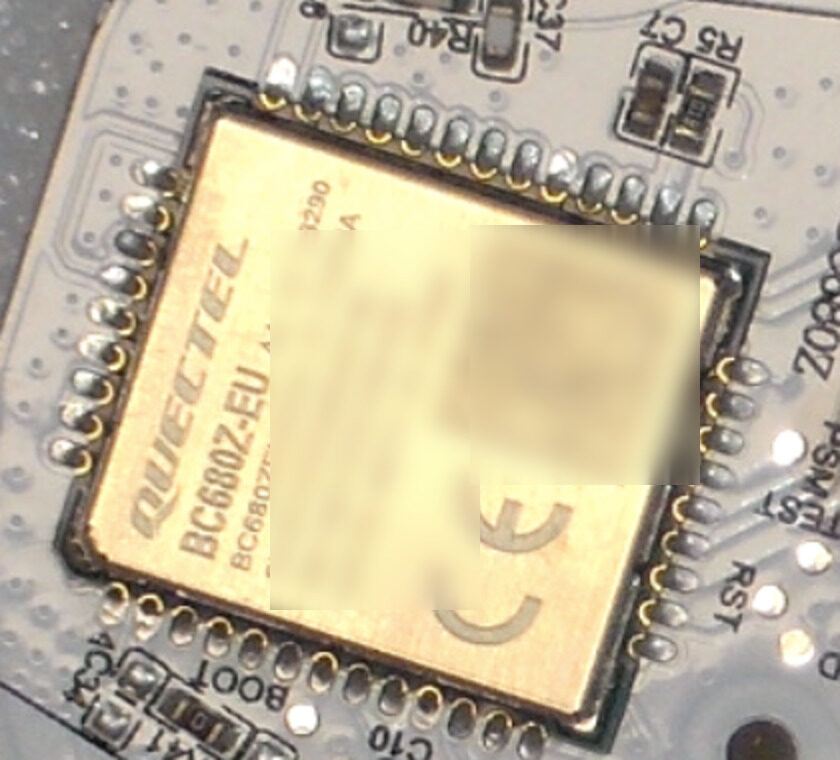
There is no SIM card slot. Instead, a small eSIM chip is soldered onto the board. According to the box, Telefónica Tech provides the connectivity for twelve years.
The module can run the device’s application software itself. Next to it sits a small, unmarked chip that most likely acts as a supervisor: it watches the button, controls the power and keeps the light flashing. Together they replace what would otherwise be a separate MCU.
The two PCB antennas
There is no antenna connector and no separate antenna part. Both antennas are copper tracks printed along the edge of the circuit board. To see them clearly, we painted the copper over a photo of the board and measured the tracks.
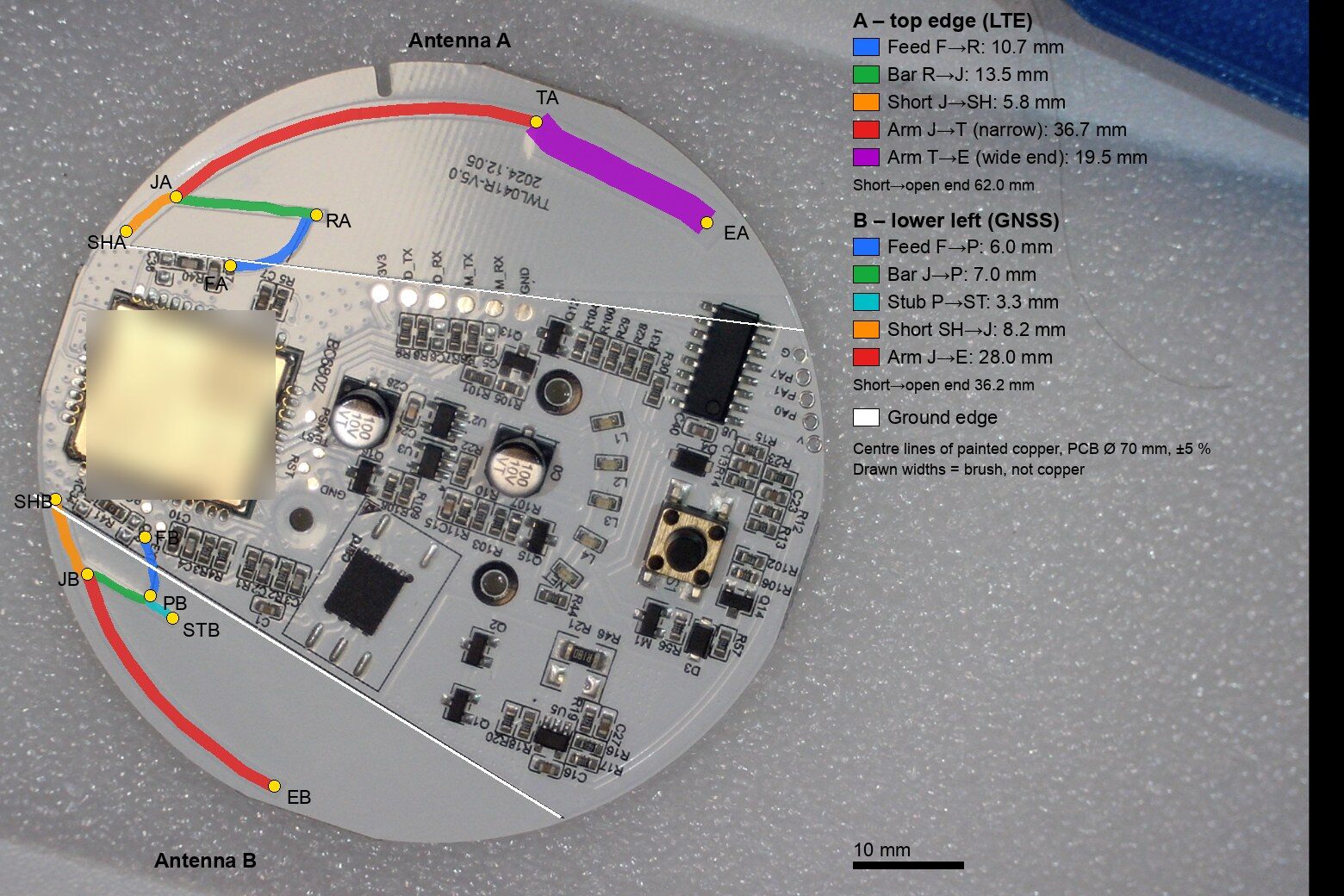
Both are inverted-F antennas, a common design for small boards. The bandwidth and efficiency of an inverted-F antenna depend on the size of the ground plane it works against. On a board this small, an inverted-F antenna typically has limited efficiency and bandwidth.
| Antenna A | Antenna B | |
|---|---|---|
| Position | Top edge | Lower left edge |
| Length (ground to open end) | 62 mm | 36 mm |
| Purpose | Cellular (NB-IoT) | Positioning (GNSS) |
| Special feature | Wider end section to tune it lower | Short extra stub at the feed |
The lengths explain the purpose. An antenna like this works best when it is about a quarter of a wavelength long. On a circuit board, 62 mm fits the 800 to 900 MHz range used by NB-IoT networks in Europe. 36 mm fits the GPS frequency at 1575 MHz.
Each antenna has a pi-matching-circuit right at the feed of the resonator. With them the manufacturer can fine-tune the antenna to the finished housing without changing the board.
At 800 MHz the wavelength is about 37 cm, and the whole board is only 7 cm across. A board this small leaves the antenna little to work against, so it typically radiates less efficiently and covers a narrower range of frequencies. NB-IoT is built to cope with weak signals, but the device then has to transmit longer, which costs more energy.
Light and power
A single 9 V alkaline battery powers everything. Two small voltage regulators turn it into the lower voltages the electronics need, and two large capacitors give the radio extra power for short transmit bursts.
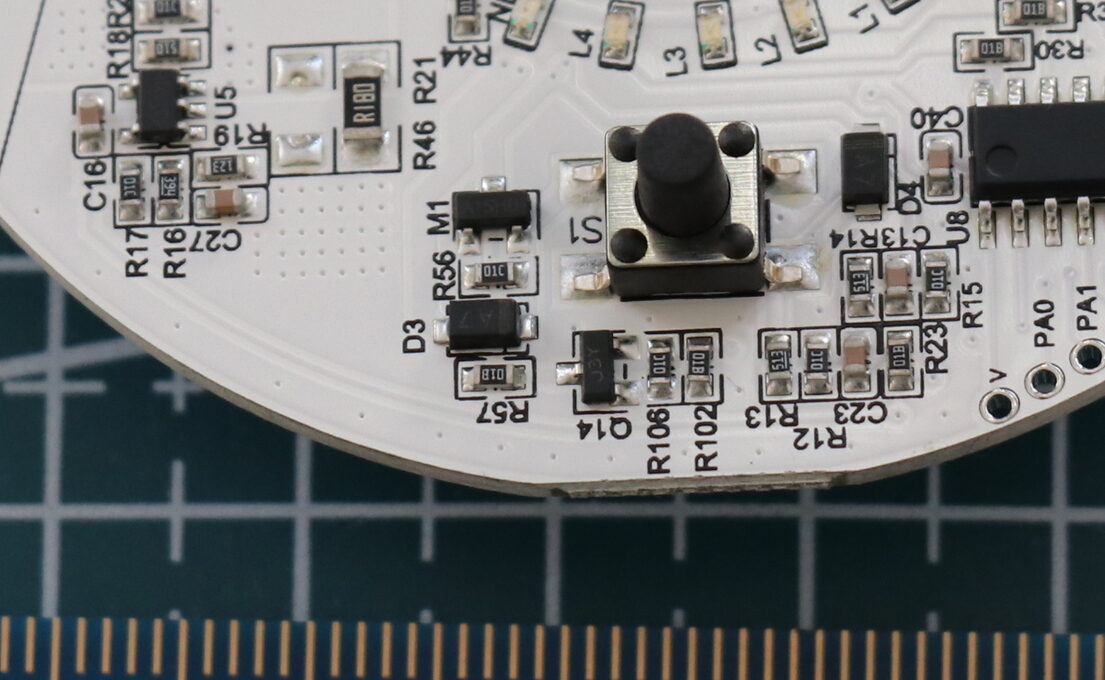
The ten amber LEDs are driven by a small controller chip. A tiny 0.18-ohm resistor measures the current, so the flashes stay equally bright as the battery runs down.
What we take away
- One board does everything. Radio, eSIM, power supply, LED driver and both antennas share a single 70 mm circuit board. That makes the light simple to assemble.
- The antennas are the critical part. The radio is an off-the-shelf certified module. The inverted-F antennas have little ground plane to work with, which typically limits efficiency and bandwidth. Measurements have to be conducted to show how this design performs.
- The housing is easy to work with. Five plastic parts, a mirrored cone, a screw or two, and the electronics are out. It is the perfect candidate for our V16 with NB-NTN connectivity.
Next, we will propose an antenna solution on a round PCB with 70 mm diameter for NB-NTN. If you are working on a battery-powered device with cellular or satellite connectivity, get in touch with us.
OSRAM, LEDguardian, Quectel, Telefónica and other names are trademarks of their respective owners. Embever is not affiliated with these companies. All findings come from our own examination of a unit bought at retail.